Mobile App Modernisation Strategy for Legacy Enterprise Applications 23 Jun 2026
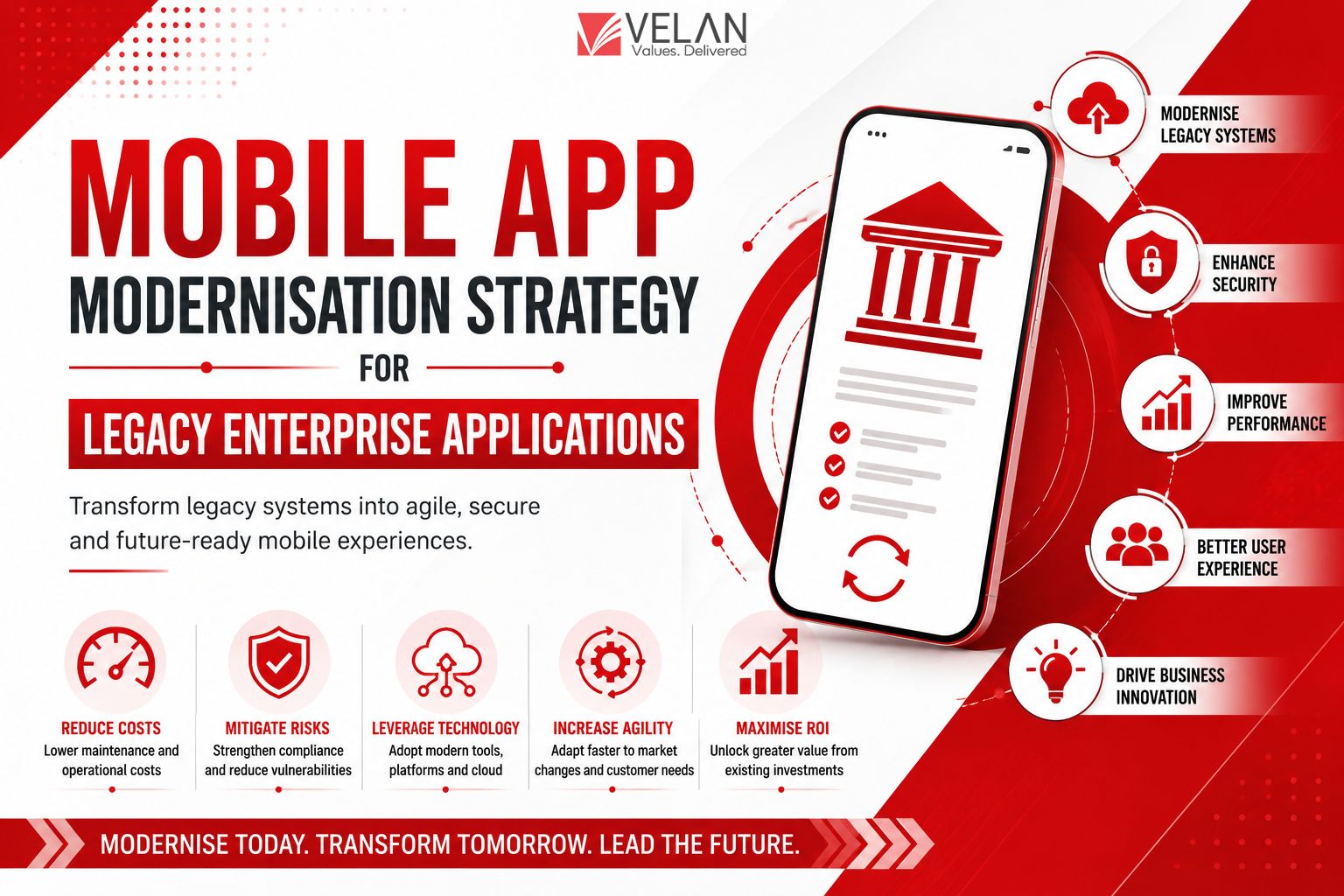
Many enterprises still have outdated mobile apps that do not generalize better with the modern business requirements. The old-fashioned systems can often mean increased maintenance costs, security vulnerabilities and performance problems. Most organisations would have a proper mobile app modernisation strategy that will help them handle scalability, provide better user experiences and reduce their technical debt. App modernisation and legacy application modernisation allow organisations to turn ageing apps into secure, efficient, future-ready solutions.
What Is Mobile App Modernisation?
Mobile app modernisation is a process of updating existing mobile applications from their legacy versions to meet business, technology, and the latest user necessities. It is about making enhancements to application architecture, code, infrastructure, security, and UI without the core business functions being interrupted.
Modernisation aims to make you more flexible, improve performance, reduce operating expense and invest in the growth of your future. Businesses often use their modernisation initiatives (including those focused on application modernisation/ legacy app modernisation ) as part of creating an agile, efficient digital ecosystem.
Why Do Organisations Invest in Enterprise Mobile App Modernisation?
There are many reasons why organisations choose to invest in enterprise mobile app modernisation:
- Increase application performance & reliability
- Decrease maintenance & support costs
- Enhance security & compliance
- Enable cloud integration and scalability
- Enhance customer and employee experiences
- Accelerate the deployment of new features
Companies expand, and the old software cannot keep up with the evolving requirements. Through enterprise modernization, businesses can stay flexible and one step ahead of their competitors.
Signs Your Enterprise Mobile App Needs To Update
It is highly indicative of the necessity:
- Application crashing/off to a slow start
- High maintenance and operational costs
- Difficulty integrating with modern systems
- Poor user engagement and satisfaction
- Security vulnerabilities and compliance risks
- Outdated user interface and navigation
- Limited scalability during business growth
Four Essential Approaches for Modernising Mobile Apps
Varied modernisation strategies cater to varied business needs.
Rehosting
Rehosting, often a lift-and-shift migration, typically means moving an existing application to a new platform without any or substantial code alterations.
Benefits include:
- Faster implementation
- Lower initial costs
- Reduced infrastructure expenses
- Minimal disruption
This method is generally the initial step in modernisation projects.
Refactoring
Refactoring means rewriting the code of the application with a view to enhancing the application structure without changing the functionalities.
Advantages are:
- Code optimisation
- Improved maintainability
- Better performance
- Support for modular architecture
Refactoring is a fundamental component of legacy software modernization. We especially focus more on it.
Replatforming
Replatforming is all about sustainable changes to support new modern platforms and cloud environments.
Typical improvements include the following:
- Cloud migration
- Backend modernisation
- Enhanced scalability
- Improved resource utilisation
This approach reaps the benefits of modernization at a lower-risk investment.
Rebuilding
With rebuilding, you will redevelop the app from scratch with more modern technologies, frameworks and tools. Benefits include:
Benefits include:
- Maximum flexibility
- Improved security
- Modern architecture
- Better long-term scalability
This is a common method used by organisations aiming to initiate massive digital transformation.
Mobile App Cloud Migration Strategies
A well-planned strategy for mobile app migration to the cloud often consists of the following:
Assess Current Infrastructure
Assess application dependencies, databases, APIs and performance needs.
Define Migration Goals
Establish objectives such as:
- Cost reduction
- Scalability
- Performance improvements
- Disaster recovery
Select the Right Cloud Platform
Implement cloud solutions based on business needs and compliance requirements.
Modernise Backend Services
Modernise legacy backend systems to cloud-native architectures and APIs.
To migrate without operational risks, many organisations become the customers of cloud migration service providers.
Enhancing Mobile Experiences with Human-Centric Design
Technology advancements alone will never be enough to reach these goals. With frontrunners of the field redesigning their apps, user expectations are experiencing a radical shift, and the unavoidable UI UX Of enterprise app redesign has become an integral part of modernisation efforts.
Your modern mobile experience should be able to deliver the following:
- Intuitive navigation
- Faster load times
- Responsive design
- Accessibility compliance
- Personalised user experiences
- Consistent branding
Better design increases user satisfaction but also adoption and productivity.
DevOps & CI/CD in Mobile App Modernization
Faster development and deployment cycles are required for modern applications.
Organisations can benefit from implementing DevOps CI CD for mobile apps:
- Automate testing processes
- Improve software quality
- Accelerate release cycles
- Reduce deployment errors
This enables companies to rapidly deploy new features or updates to an application while ensuring that the application remains stable.
Security Considerations During Modernisation
Security should be part of every step of modernisation.
Key security practices include the following:
- Multi-factor authentication
- Data encryption
- Secure API management
- Identity and access controls
- Vulnerability assessments
- Compliance monitoring
Modern security frameworks help organizations protect sensitive data while meeting industry regulations.
Legacy to Microservices Migration Strategy
Many enterprises are replacing monolithic applications with microservices-based architectures.
Benefits of microservices include:
- Independent service deployment
- Greater scalability
- Improved fault isolation
- Faster development cycles
- Better system flexibility
The use of a phased migration process will allow companies to gradually update key elements of the application so that they do not have to rebuild the entire application all at one time.
As we move forward with the modernisation of our apps, this type of process is becoming more common in many of our company’s enterprise app modernisation initiatives.
ROI/Costs Associated with Mobile App Modernisation
While it will cost money to modernise your mobile apps, the potential financial advantages typically far exceed the costs.
| Factor | Legacy Apps | Modernized Apps |
| Maintenance Cost | High | Lower |
| Scalability | Limited | High |
| Security | Weak | Improved |
| User Experience | Outdated | Modern |
| Deployment Speed | Slow | Faster |
An effective mobile application modernisation service provides value through enhanced productivity, decreased operating costs, and improved user experience.
Common Challenges in Legacy App Modernisation
Organisations often encounter obstacles during modernisation projects, including:
- Complex legacy architectures
- Limited documentation
- Integration challenges
- Budget constraints
- Resource shortages
- Security concerns
- Resistance to organisational change
Proper planning, stakeholder alignment, and experienced modernisation partners can help overcome these challenges.
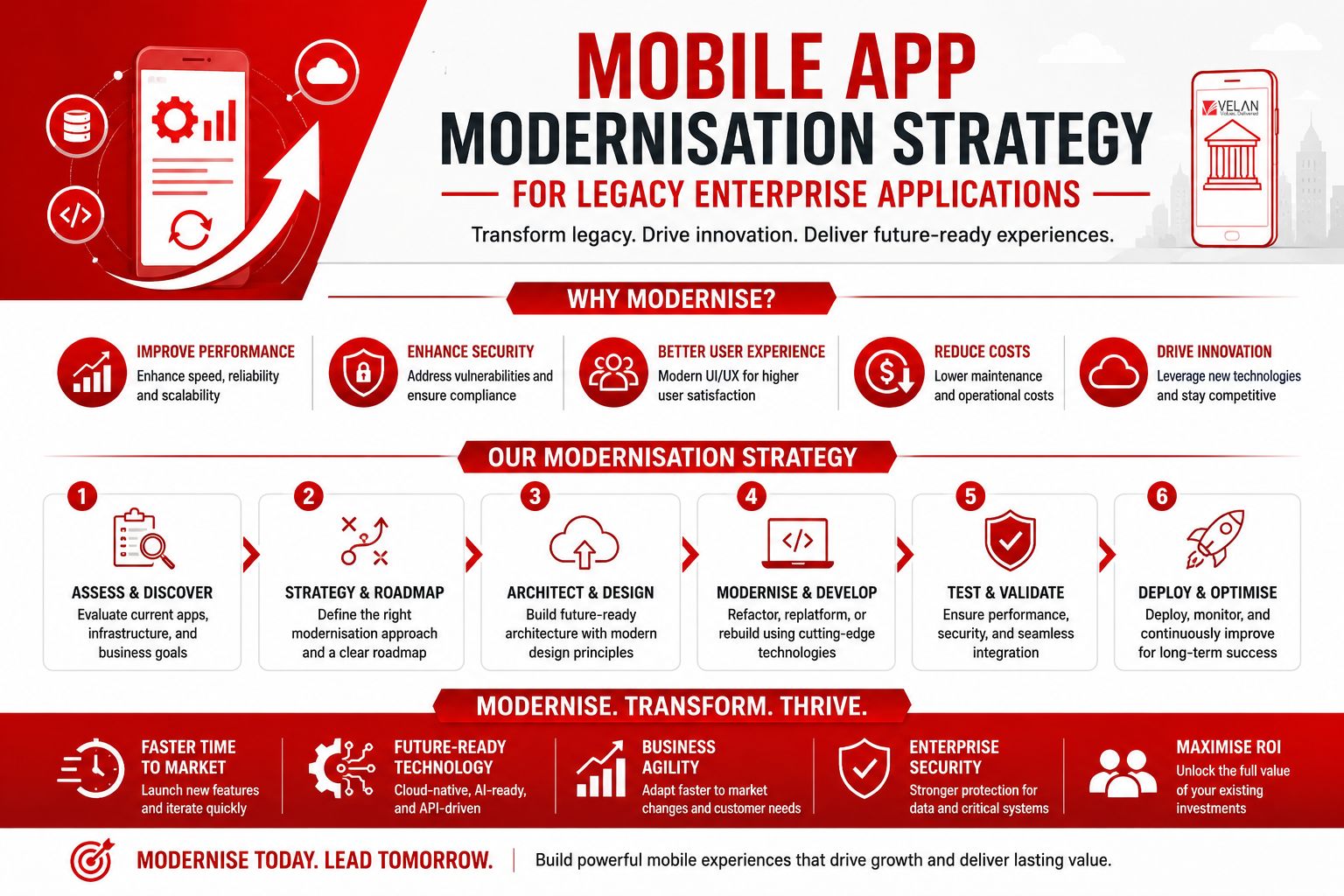
Future Trends in Enterprise Mobile Modernisation
The future of legacy system modernisation will be shaped by several emerging technologies:
- Artificial intelligence integration
- Native cloud development
- Low-code and no-code platforms.
- Predictive analytics
- Hyperautomation
- Edge computing
- Advanced cybersecurity frameworks
- Containerisation technologies
Legacy system modernisation through these new technology trends could provide organisations with the ability to adapt to rapidly evolving business needs in order to maintain their position as competitors.
Conclusion
Older mobile applications can hinder innovation for companies. They create an additional financial burden for organisations. Additionally, they provide the opportunity for security breaches. With a basic mobile app modernisation approach, enterprises can convert legacy systems into good-performing, secure and rapidly scalable platforms.
Modernization is to deliver things like rehosting, refactoring, replatforming, and rebuilding in ways that maximise performance and minimize tech debt as well as enable growth. Modernization will have a major role as one of several possible pathways for digital transformation when combined with the appropriate cloud adoption, modern UI/ux design, dev options, and microservice architecture.
FAQs
Why do enterprises modernise legacy apps?
The purpose of modernising legacy apps is to lower maintenance costs, increase security, streamline UX, capitalise on high growth & quickly propel innovation.
What is the best strategy for legacy mobile app modernisation?
The selection of the best approach for an organisation is based upon several factors, including desired outcomes (goals), complexity of the project (application) budget and technology needs. These approaches are typically referred to as rehost, refactor, replatform and rebuild.
How long would a mobile application modernisation take?
The project timelines vary by the application size and complexity. IT modernisation can last from a couple of months to more than a year.
What are the advantages of cloud migration for mobile apps?
Cloud migration is a huge advantage when it comes to mobile apps because it gives companies better scaling (ability to grow), reliability flexibility , disaster recovery, and cost savings compared to traditional “on-premise” Data Centers. It also allows companies to take advantage of modern application architecture.
What are the costs of enterprise app modernisation?
Older enterprise apps create new risks to your company’s security, performance, regulatory compliance, higher maintenance costs, and bad user experience.
Costs vary depending on application complexity, modernisation approach, infrastructure requirements, and development resources.
What are the risks of using outdated enterprise apps?
Running older versions of enterprise software applications creates a number of potential risks; most notable are security breaches, poor or decreased system performance, non-compliance issues, higher maintenance costs, and poor user experience.