Flutter vs. React Native vs. Native Apps: Which Is Best for Business Apps? 15 Jun 2026
Most organizations have to deal with rising operating costs, and they update themselves as much as possible by shifting towards cross-platform app development solutions such as Flutter and React Native so that they can reduce the number of developers based on various criteria. But the most significant aspect—the selection of the right mobile app development framework—is crucial, as it directly impacts app performance, scalability, maintenance, security, and user experience.
This blog serves as a reference to help you decide between Flutter vs. React Native and native app development solutions for enterprises.
What is Flutter?
Flutter is an open-source framework by Google for producing Android and iOS apps with one and the same codebase. It uses the Dart programming language and has a lot of flexibility through widgets to create great UI.
Here are the benefits of Flutter app development:
- Single codebase for multiple platforms
- Fast development with hot reload
- Attractive and customisable UI
- Strong performance
- Easy maintenance
What is React Native?
Its framework design with meta by the name of React Native allows developers to build mobile apps in JavaScript & react.
For most small businesses, react native app development is the way to go, as it offers a quicker turnaround time and existing JavaScript skill set can be used by web developers.
Benefits include:
- Code reuse across platforms
- Faster MVP development
- Large developer community
- Easy maintenance
- Strong ecosystem support
What Are Native Apps?
Such applications are concretely coded in a single language for the Android or iOS platform, which is usually Kotlin/Java (Android) or Swift (iOS).
Benefits of Native App Development:
- Best performance
- Strong security
- Full access to device features
- Better platform integration
- Excellent user experience
Major Differences: Flutter vs React Native vs Native
The discussion on react native vs. Flutter vs Native. Here’s a side-by-side comparison.
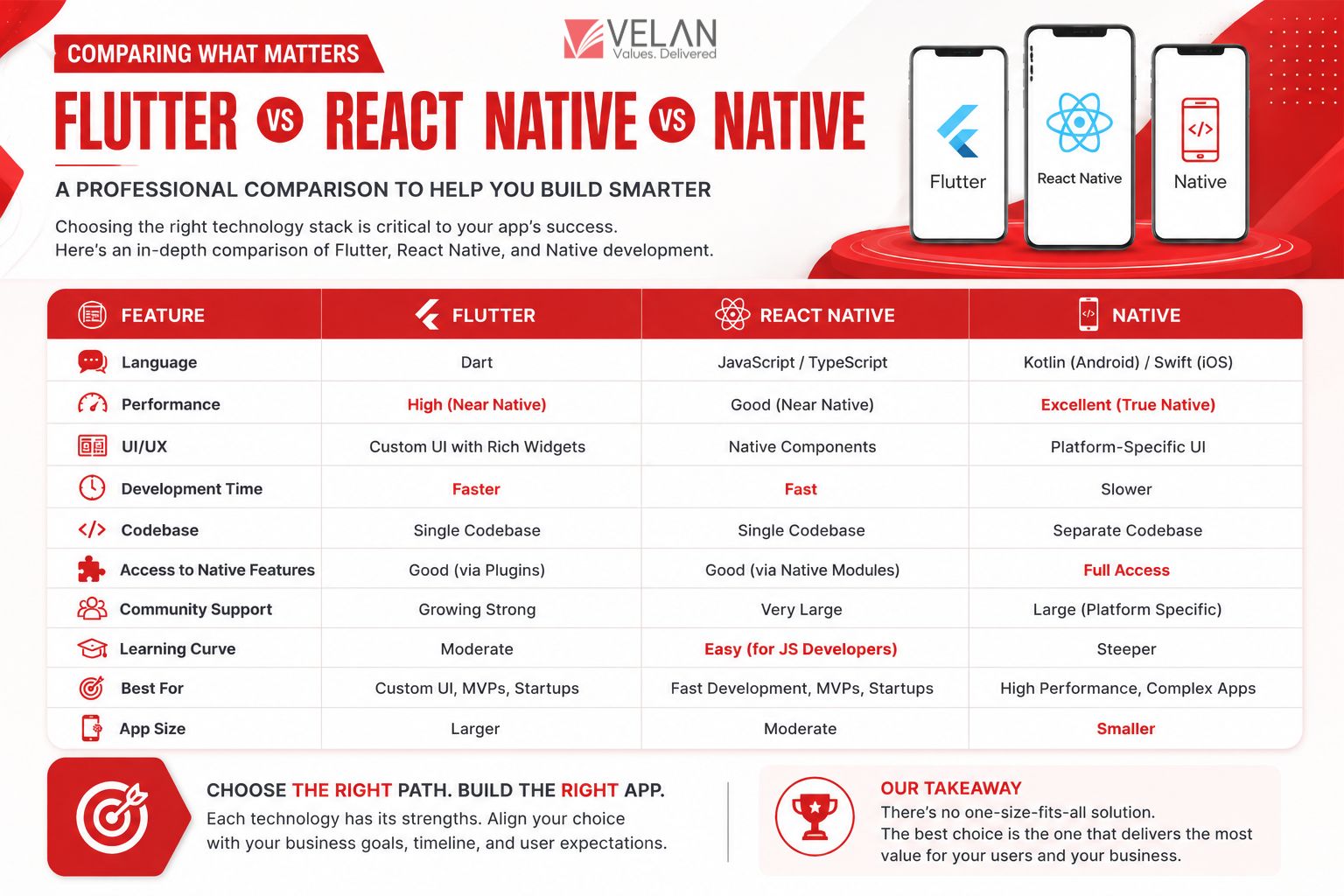
| Feature | Flutter | React Native | Native |
| Performance | High | Medium-High | Best |
| Development Speed | Fast | Fast | Slower |
| Cost | Lower | Lower | Higher |
| UI Flexibility | Excellent | Good | Excellent |
| Scalability | High | High | Best |
| Maintenance | Easier | Easier | Complex |
| Platform Access | Medium | Medium | Full |
When comparing native vs cross-platform apps, businesses must balance development costs with long-term performance requirements.
What Is Best For Your Business Apps?
What is the opportunity that follows your business targets?
Choose Flutter if:
- A beautiful and consistent UI is what you need.
- You need a single codebase.
- Faster development is important.
Choose React Native if:
- Your team knows JavaScript.
- You need a quick MVP launch.
- You are developing SaaS or startup-related products.
Choose Native Apps if:
- You need the highest performance.
- Security is a top priority.
- The app calls for deep hardware integration.
Performance Comparison
Native apps win in a Flutter vs native performance comparison because they run on the operating system itself.
Flutter delivers near-native performance and is perfect for most business apps.
Though React Native is slower than native apps (for complex use cases), it works fine for standard business logic/use case scenarios.
Performance Ranking:
- Native Apps
- Flutter
- React Native
- Development Cost Comparison
In typical scenarios, the cost of Flutter vs native app development is lower since there is only one codebase to be used for Android and iOS.
Development costs are reduced as react native is very cost-effective, and startups tend to choose this option generally.
Native development is costlier since separate apps need to be developed and maintained on all platforms.
Scalability & Enterprise Readiness
Native apps are the most scalable and controllable option for large enterprise projects, depending on your hours.
Flutter is often used to develop enterprises since it supports scalable development but requires less maintenance.
React Native also scales well, but it may require extra optimisation as apps grow larger.
UI/UX Experience Comparison
Flutter is developed to build gorgeous-looking, highly customisable interfaces.
React Native — a framework with which you work with real native UI building blocks to feature a user experience similar to that of the actual platform.
You get the smoothest experience with native apps that follow design guidelines for each platform.
Security Considerations
Usually, native applications are the most secure since they have direct access to platform security. Although both Flutter and React Native can be used to create secure apps, some of the advanced security features may require code.
Conclusion
It is varied when you are comparing Flutter vs React native and native apps; there is not a common solution. Best suitable for faster development, lower prices, and cross-platform app development. Both frameworks allow creating an application in a short period of time with one codebase. However, for organisations that demand the highest possible performance, superior security, and future-proof stability, native app development is still the best option. Which is the best mobile app development framework ultimately depends on your budget, goals of your business, application needs and more.
FAQs
-
Which is better: Flutter or React Native?
The answer here really depends on your requirement. Flutter is good for customisation and performance of the UI, and React native still a communication bridge between the JavaScript framework and the native platform, which makes it a favourable choice for JavaScript-using teams with a need to build the product faster.
-
Are native apps faster than Flutter?
Yes. Native apps interact directly with the OS, which is why they provide better performance than any other kind of app. However, most of the time Flutter’s performance is comparable to that of native Applications for business apps as well.
-
Are enterprise apps built with Flutter?
Of course. Flutter has come a long way and can serve for scalable enterprise apps built with security and performance in mind.
-
What are the disadvantages of React Native?
In the case of very intricate apps, the framework could cause performance problems, and you may even have to resort to native code for the implementation of new features.
Both frameworks are great. Flutter excels in UI customization and performance, whereas React Native is best for teams with JavaScript skills and who need to develop fast.
-
Are native apps faster than Flutter?
Yes. Native apps generally provide the best performance because they communicate directly with the operating system. However, Flutter performance is very close to native in most business applications.
-
Is Native development a costly decision?
Native development is often worth the extra investment for applications that demand maximum performance, advanced security or deep hardware integration.
-
Which framework is less expensive for app development?
We can say that React Native and Flutter work by sharing code across platforms, so it is pretty obvious that both of them will be less expensive than native development.