Custom Mobile App Development Architecture: Monolithic vs. Microservices 9 Jun 2026
Apart from the features and user experience of a mobile application, its success also relies on the mobile app architecture for any given app. Choosing a proper architecture is critical for the performance, scalability, maintenance and future growth of businesses investing in custom mobile app development.
One important choice in modern organisations today is monolithic vs microservices. Though both architectures are capable of supporting mobile applications, they differ in many aspects such as their design, deployment and maintenance. This decision affects the speed of development and how many resources it will take to operate them, as well as the versatility with which we can scale applications.
This guide helps businesses to find out the differences between monolithic architecture vs microservices architecture and which one is more suitable for their business mobile applications.
Understanding Mobile App Architecture
Mobile app architecture is the structural design of an app, consisting of front end, back end, and databases, as well as their APIs (Application Programming Interfaces), integrations, etc. Smooth performance, easier maintenance, scalability, and better security are the hallmarks of a well-thought-out architecture.
The architecture typically consists of:
- User Interface (UI)
- Business Logic Layer
- Data Storage Layer
- API Integrations
- Mobile backend architecture
When businesses plan for long-term growth, choosing the best scalable mobile app architecture is a necessity from the start.
What Is Monolithic Architecture?
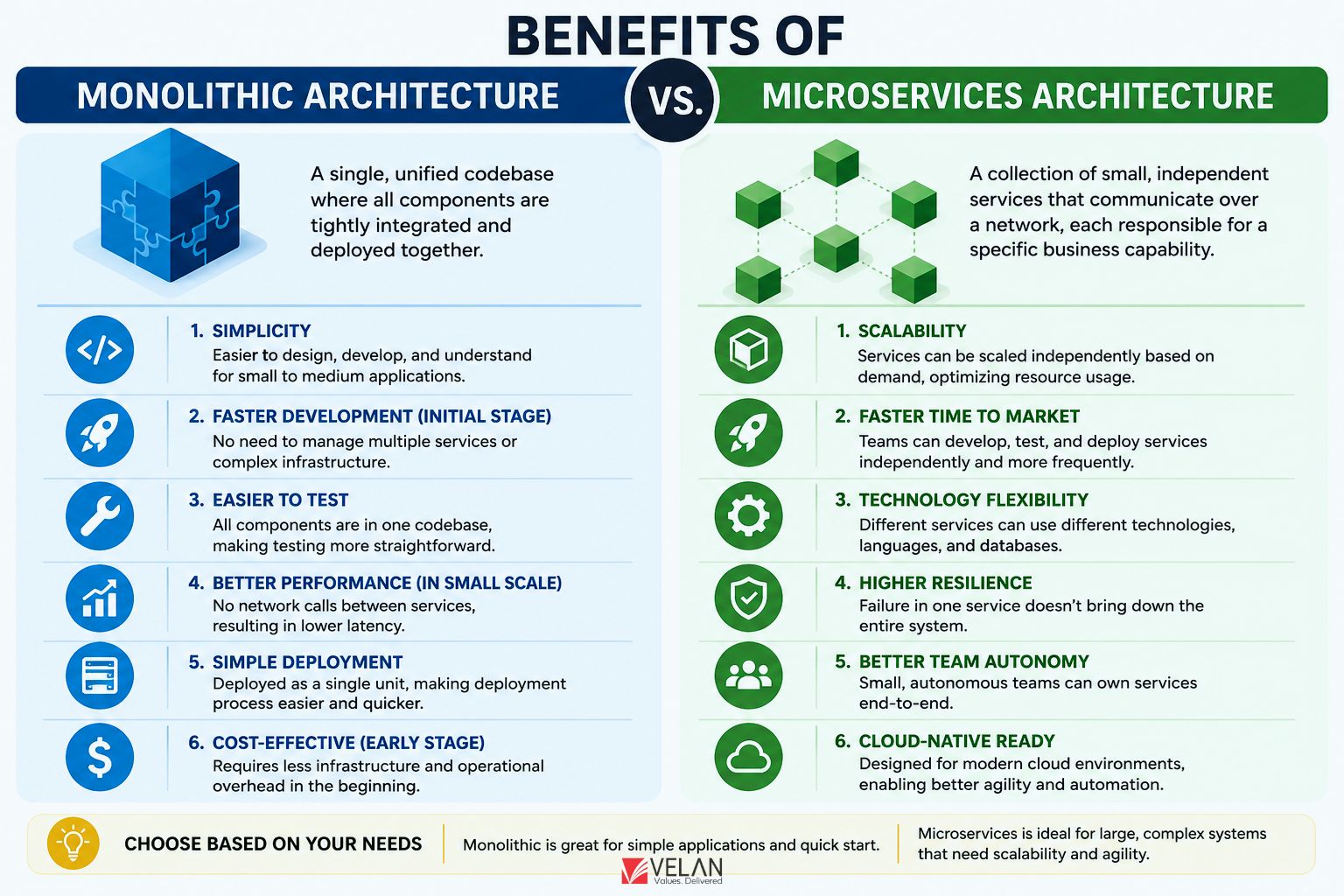
Monolithic architecture is a traditional application structure with all components built together as a single unit and deployed once. It has UI, business logic, database interaction and backend services wired together in one codebase.
Example of Monolithic Architecture
Imagine a food delivery mobile app that includes functionality for:
- User registration
- Restaurant listings
- Order management
- Payment processing
- Delivery tracking
Advantages of Monolithic Architecture
Simpler Development Process
Faster development and deployment — Since everything exists within a single codebase, small teams can deploy their applications a lot faster.
Easier Testing
As most of the functionality is integrated, testing workflows are usually straightforward.
Lower Initial Costs
In their early stage, monolithic apps usually require fewer infrastructure resources. This is, though, a different story for startups and small businesses.
Faster Initial Deployment
The MVP can be delivered to users at lightning speed with a single service to manage.
Challenges of Monolithic Architecture
Limited Scalability
You are dealing with scaling individual components, which is increasingly difficult since the whole application has to scale together as users’ requests increase.
Maintenance Complexity
Time has passed, and the problems of large codebases do not disappear.
Slower Updates
Even small feature updates necessitate redeployment of the whole application.
Technology Restrictions
Across the whole assignment, each team is mostly held to one technology stack.
What is Microservices Architecture?
Microservices architecture divides an application into small, independent services.
Each of these services is implemented to handle a business function and operates via APIs with other services.
This architecture is widely used for new-age enterprise mobile app development projects where flexibility and scalability are required.
Challenges of Monolithic Architecture
Limited Scalability
You are dealing with scaling individual components, which is increasingly difficult since the whole application has to scale together as users’ requests increase.
Maintenance Complexity
Time has passed, and the problems of large codebases do not disappear.
Slower Updates
Even small feature updates necessitate redeployment of the whole application.
Technology Restrictions
Across the whole assignment, each team is mostly held to one technology stack.
What is Microservices Architecture?
Microservices architecture divides an application into small, independent services.
Each of these services is implemented to handle a business function and operates via APIs with other services.
This architecture is widely used for new-age enterprise mobile app development projects where flexibility and scalability are required.
Advantages of Microservices Architecture
High Scalability
One of the most significant advantages of microservices architecture for mobile applications is the independent scaling capability of individual services.
For instance, in holiday sales, the payment service may require further resources.
Quicker Development Cycles
It enables multiple dev teams to work on separate services simultaneously.
Greater Flexibility
Teams can choose different programming languages and technologies for different services according to the needs of the project.
Better Reliability
If one service goes down, it does not affect the others.
Easier Feature Deployment
New features can be created independently without endangering the whole application process. Microservices tend to be a promising option for businesses when it comes to building mobile microservices apps due to these advantages.
Challenges of Microservices Architecture
Increased Complexity
Multiple services mean you have to manage it much more up front and with infrastructure too.
Higher Operational Costs
More tools are available to get monitoring, deployment, logging and security, for example.
Data Management Challenges
One of the challenges is that data tends to be inconsistent across multiple services.
API Management Requirements
Application programming interfaces (APIs) play an essential role in enabling seamless interaction among different services.
The role of an API gateway is to serve as a single point of access that directs the requests coming from mobile applications to the backend services. Besides this, it also handles security, authentication, and traffic control aspects.
Monolithic vs Microservices for Mobile Applications
There are few things to consider rather than monolithic vs microservices for mobile apps.
Development Speed
Often, Monolithic architectures allow you to get going with small projects much faster.
Microservices might entail some additional setup but enable speedier innovation over the long haul.
Scalability
Monoliths can scale as one.
Microservices also allow us to unify the back-end architecture of our mobile apps in a scalable way, as we can scale services individually.
Maintenance
The bigger the monolithic applications, the harder they are to maintain.
Microservices break things down into manageable layers and make maintenance so much easier, as each part of a business function is separated into components.
Deployment
Monolithic applications require full-system deployment.
Microservices enable deploying only certain services selectively.
Cost
Monolithic systems are usually less expensive to get started with.
Microservices incur a much higher upfront investment but often yield long-term business value that many growing organisations find irresistible.
Mobile App Architecture for Enterprise Mobile Apps
Choosing the best architecture of enterprise mobile applications will depend on the business goals, planned growth, and characteristics of operations.
Monolithic Architecture
Choose monolithic architecture when:
- Building an MVP
- Launching a startup application
- Managing a small development team
- Working with limited budgets
- Supporting relatively simple business processes
Microservices Architecture
Choose a microservices architecture when
- Supporting large user bases
- Requiring frequent feature releases
- Managing multiple development teams
- Building enterprise-level platforms
- Planning long-term scalability
Microservices are the architecture of choice for many organizations that develop enterprise mobile apps, as they offer a more flexible approach to architecting an app that needs to scale.
Mobile App Modernisation and Architecture Transformation
When their systems expand and need more scalability, many companies transition from monolithic design to microservices. App modernisation services frequently assist businesses in making this shift.
- Split large applications into smaller services
- Improve scalability
- Modernise infrastructure.
- Enhance security
- Reduce technical debt
Mobile app modernisation architecture strategy helps in keeping businesses aligned with the evolving customer expectations without having to build apps entirely from scratch.
Conclusion
Probably the biggest decision in custom mobile app development. Microservices architectures are better suited to modern-day digital apps; they may have higher costs in terms of overhead, management and maintenance, plus relatively few existing systems use microservices architecture at this stage, but monolithic architecture is simpler and has lower initial upfront costs.
A monolithic approach is good enough for startups and smaller projects. That said, scalable mobile app architecture based upon microservices is a nice-to-have for businesses that are growth- and innovation-focused—particularly enterprises specialising in mobile application development.
Every organization continues to invest time and money in digital transformation and app modernization services, but knowing the strong points of both architectures and also their limitations is the best way to keep your mobile apps efficiently aligned with your future expansion plans.